WHAT IT DOES
Built for judgment.
Six processors on one analyzer, checked against an automated regression suite on every build. For engineers who master for a living, not one-knob shortcuts.
01PARTIAL EQ
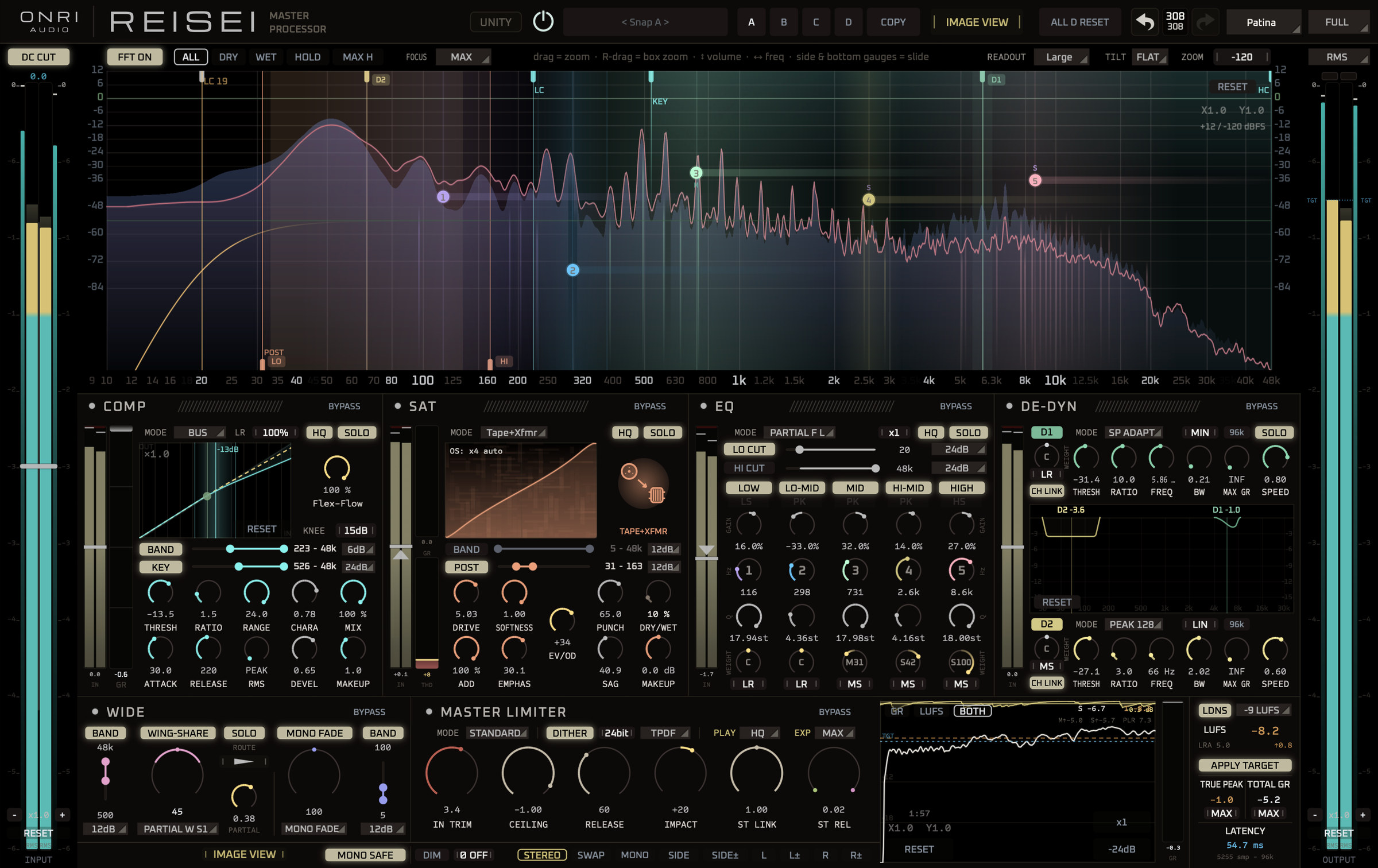
Not a filter. A conventional EQ shapes the outline of a sound; PARTIAL works inside it, on the harmonics it is actually made of. It locks onto the harmonics already in the sound and strengthens the ones you choose, phase-coherent — rescaling content that is already there rather than generating anything new. Masters that feel light or edgy settle and sit: the density you reach for with better converters, without the colour and cost of analog. Pull a harmonic the other way and it cancels in anti-phase. WEIGHT leans each band toward Mid or Side — the signal itself stays L/R. And PARTIAL sits alongside a complete conventional EQ — five classic models, from NATURAL to linear phase — so the everyday moves stay everyday.
02DE-DYN
Two dynamic band processors, D1 and D2, fully independent of each other — de-ess with one while the other holds down a resonance. The flagship mode, SP ADAPT, works across the whole region you set instead of sitting at one fixed frequency, so the reduction follows a resonance as it moves and only the moments where energy actually jumps come down. FREQ and BW take that region from a tight spot to a wide span, and THRESH means the same thing however wide you open it — widening never makes it more aggressive, so you can search wide and then narrow down without re-setting the threshold. The other modes are dynamic PEAK bells — you choose the edge, from gentle to surgical — and dynamic HI/LO shelves. LISTEN monitors exactly what is being removed, and a 2D meter draws the reduction across time and frequency, so you can read what happened, when, and where.
03WIDE
A widener and a monoizer in one, worked by eye and ear. WING-SHARE adds side energy without breaking phase; push it past its switch point and it fades the in-band Mid away, reaching Side alone at the top of its travel. MONO FADE goes the other way, folding a band back toward Mid, so the lows stay mono while the image stays true — and ROUTE decides which of the two comes first. PARTIAL WIDER widens by tracking harmonics: what it adds is pure Side, so folding to mono simply removes it and leaves your centre untouched. Between WIDE and the limiter, MONO SAFE holds the L/R correlation at or above zero, pulling Side back only as far as it takes — fast to protect, slow to let go. MONO FADE is where you shape mono compatibility on purpose; MONO SAFE just catches what gets past. Off, it is not in the signal at all; on, it works even with WIDE bypassed. Grab the band handles in IMAGE VIEW and shape the image where you can see it, with the change under your fingers.
04COMP & SAT
Program-dependent dynamics and analog colour. COMP's Flex-Flow follows the material, with RANGE to stop over-squashing and PEAK / RMS detection. SAT gives saturation a grammar instead of a single knob: 15 models in five menu groups, EV/OD to re-weight the even and odd harmonics a model generates, and a THD read-out with peak hold so you can see what you added. PUNCH keeps the attack out of the saturation — a kick or snare edge passes clean while the body keeps its colour. SAG makes the drive itself move the way a real supply does under load, and every model carries its own supply profile, so tape, tubes and the clippers behave differently. Two band controls sit on the analyser itself: one decides which part of the spectrum is driven at all, the other band-limits the saturated signal on its way out. COMP, SAT, EQ and DE-DYN can be reordered freely.
05MASTER LIMITER
The finish, metered. Four modes, each its own design rather than a preset of one algorithm — STANDARD (the house sound, and the default), PRESSURE (weight), SMOOTH (the softest; costs noticeably more CPU) and CLEAN (transparent, and the one mode with no IMPACT). A single IMPACT knob, reading −100 … 0 … +100, sets how far each mode leans into its own character; zero is the mode as voiced. Playback and export quality are set independently, and REISEI detects your host's offline render and switches by itself. True-peak detection is always on and follows the quality setting, oversampling the detector up to ×16 at MAX. The ceiling you set is the ceiling you get. Five dither curves at 24 or 16 bit, and a gain-reduction history you can actually read. ITU-R BS.1770-4 metering — Integrated, Short-term, Momentary, LRA and True Peak — with streaming targets (−9 / −14 / −16 / −23 LUFS) and one-click APPLY TARGET: it gets you close, and the meters and your ears finish the job.
06One screen, honest
The FFT is the control surface. Every EQ band, cut point and marker sits on the analyzer itself, so you drag the processing onto the sound you are already looking at. Zoom it directly: left-drag to scale, right-drag to box a region and jump straight into it, double-click to go back — and go fullscreen when the detail matters. The same double-click types a value into any knob or band edge, and clears a held reading — true-peak and gain-reduction maxima, loudness, the zoom. Every processing module except the limiter has a SOLO switch; engage it and touching a control brings that part under the ear, so a move can be checked instead of guessed at. What SOLO isolates is chosen to suit each module, so it stays useful rather than literal. A UNITY match holds output level to input, so louder never flatters the decision. 999 steps of undo, A / B / C / D, and a build that passes Apple's auval -strict.